
Pulaski County Court Calendars Explained
Pulaski County Superior Court belongs to the Oconee Judicial Circuit, which publishes its calendar as a PDF. That document is the best public source for Superior Court terms and settings. Dates run down one side. Judges spread across four columns. Pulaski entries carry labels like Civil Term, Criminal Term, civil motions, arraignments, revocations, bonds, pleas, habeas matters, and criminal calendars. Keep in mind that a term entry marks a block of court work, not one person's hearing.
The circuit itself describes these calendars as general guides. A planning calendar may lag behind a late reset, a judge swap, or the order in which cases get called. The Clerk of Superior Court confirms any Superior setting. Probate, Magistrate, and Hawkinsville Municipal Court keep their own calendars. None offers a comparable public date-search page.
Pulaski Calendar’s Four Judge Columns
The Oconee calendar lists four judges. Judge Wall, Judge Johnson, Judge Kaufold, and Judge Burton hold one column apiece. Scan the date row across all four. A Pulaski County label with its calendar type may sit under only one judge. A blank cell elsewhere does not mean the county has no court that day. The Oconee Judicial Circuit page explains the calendar's source and tells readers to verify settings.
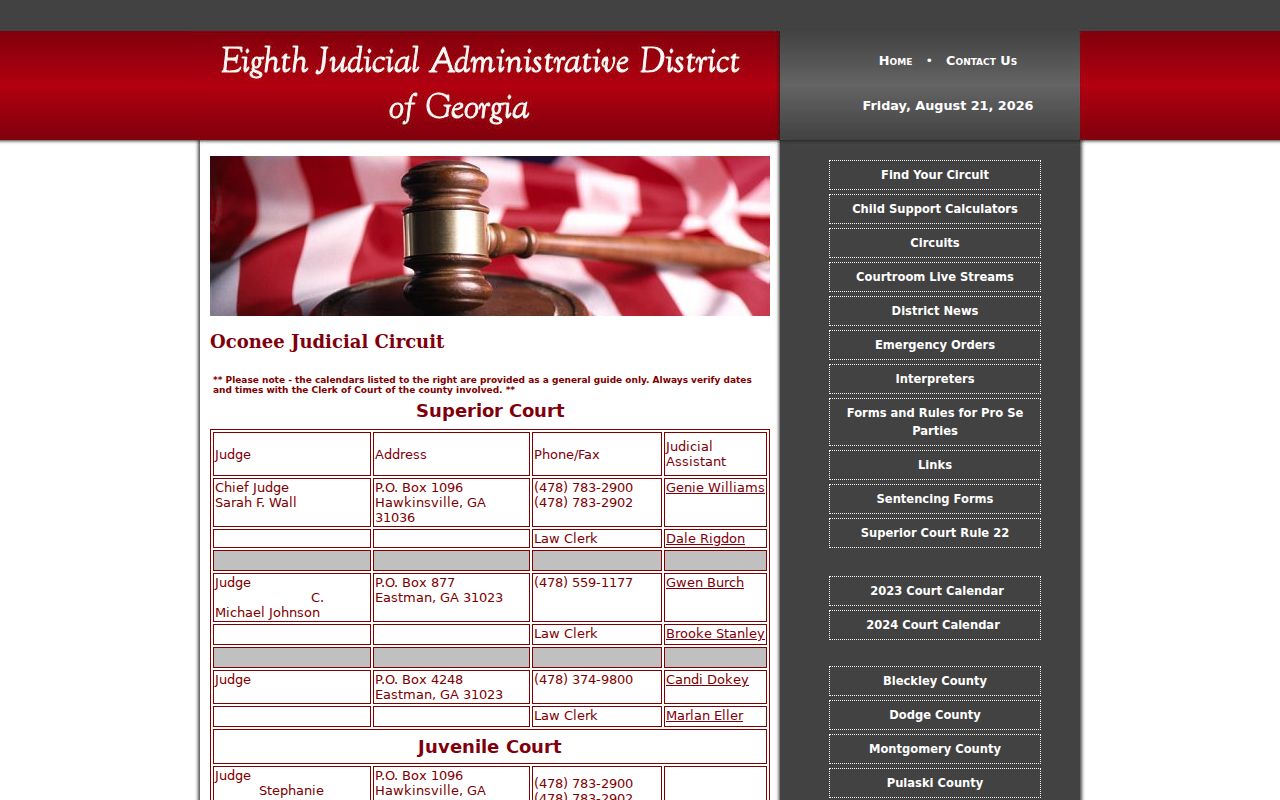
A judge column gives no party name, case number, courtroom, or full docket. Treat its label as a starting point. Then give the clerk the case number and party name if you have them.
Finding Your Pulaski Court Date
Work the channels in order. The right office depends on the court that issued the notice, not just the county name printed on it.
- Read the citation, notice, or prior order for the court name and case number.
- For Superior Court, check the Oconee calendar PDF by date, judge, county, label, and time.
- Check the local clerk calendar route, while recognizing that it displayed no calendar data during research.
- Call Superior at (478) 783-1911, Probate at (478) 783-2061, Magistrate at (478) 783-1357, or Hawkinsville Municipal at (478) 892-3240.
- Visit the right counter if phone and web sources do not resolve the setting.
- Ask the clerk to repeat the date, time, court, setting type, and appearance method.
No statewide Georgia calendar pulls these courts together. Georgia E-Access routes records to providers, but it does not search dates. A Pulaski County case lookup may surface a docket entry, yet the calendar and the clerk still matter most.
Pulaski County Court Setting Fields
A setting is a scheduled court event, and it is not always a trial. Read its fields as a set. The circuit calendar publishes the date, the judge column, the county, the calendar label, and the time. No party name or case number appears there.
| Date | The day assigned to the Pulaski term or event. |
|---|---|
| Time | The stated call time, which may cover a group of matters. |
| Courtroom | Not supplied in the verified PDF entry; confirm it with the clerk. |
| Judge | The circuit judge column containing the Pulaski entry. |
| Setting Type | A label such as arraignment, motions, pleas, criminal term, or civil term. |
A term label is not a party record; it describes a block of work. Bring your full setting notice, since it may hold detail the public calendar leaves out.
Pulaski Calendar Labels in Plain Terms
Local labels explain why a calendar entry needs context. An arraignment is where a criminal charge is addressed and a plea may be entered. A motion asks a judge to rule on an issue. A revocation setting is different. It deals with whether an existing probation, bond, or other status should be withdrawn. A plea setting can end a criminal matter. It resolves the case without a trial.
- Civil Term
- A block for civil business, not proof every civil case is set.
- Criminal Term
- A block for criminal matters at several possible stages.
- CMJ
- A label observed in the official calendar; ask the clerk for its exact local use.
- Habeas Corpus
- A case that tests the legal basis for detention or custody.
- GJ
- An abbreviation observed beside a civil term that the public PDF does not define.
These terms help you frame a call to the clerk. They never replace a notice or current instruction.
Pulaski Livestreams Are Not Settings
The Oconee Circuit livestream page lists a Pulaski County courtroom. Watching an authorized proceeding there is possible. A stream is not a court calendar, though. It may sit inactive. It may run behind, or it may carry a different case. It also never excuses a required appearance. The official circuit livestream page holds the source and the Rule 22 notice.
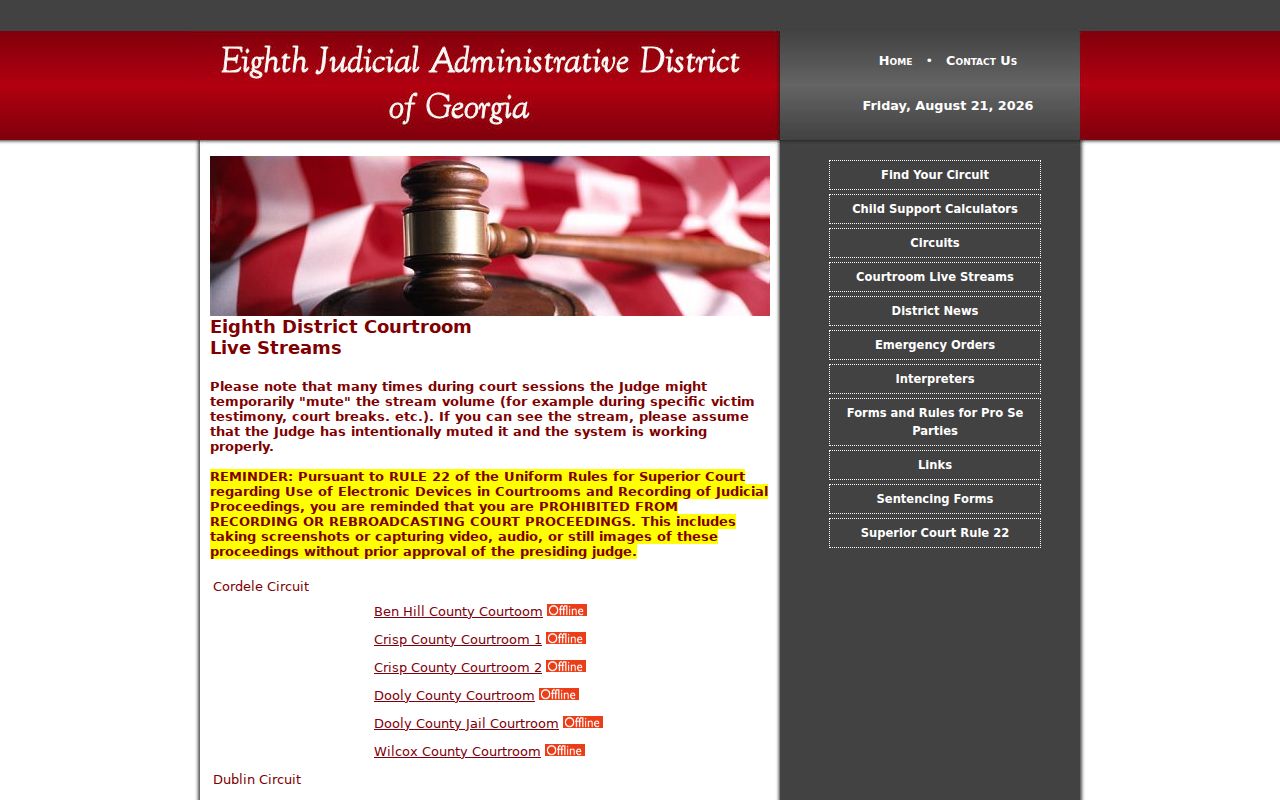
Rule 22 restricts recording and rebroadcast. Never record, capture, or share a proceeding without the judge's approval. Confirm the date and your appearance method too.
Pulaski Continuances and Resets
A continuance pushes court action to a later date. A reset assigns a new setting. A cancellation removes a listed event, but removal does not mean the case was dismissed. No public sample shows how these changes appear in the local Icon system. Assume nothing about status codes or update speed.
Check the newest filed order or notice first. Then call the clerk of the court that owns the matter. For Superior Court, weigh the circuit calendar against the Clerk of Superior Court's confirmation. For Probate, Magistrate, or Municipal Court, contact that office directly. Counsel, if any, may hold a newer notice. Keep notes on your call, but rely on the official court notice.
When Pulaski’s Calendar Is Blank
The Pulaski Clerk maintains a Court Calendars URL, but the page shows no calendar content. A blank page does not mean court is closed, hearings are absent, or a case has ended. That route simply offers no usable public calendar data right now.
Use the fallback chain. Check the Oconee PDF for Superior settings, then call the proper Pulaski County clerk with the case number, party name, and date on the last notice.
For weather, holidays, or a same-day question, a phone call beats an old static PDF. The county posts no reliable closure calendar or public daily docket. Ask whether the setting changed and where to appear.
If You Miss a Pulaski Setting
Move quickly after a missed setting. Call the court listed on the citation, order, or notice. Have the case number ready. The clerk will also want the full party name. That includes the date you were scheduled and the kind of matter it was. Ask if the judge has issued a warrant, an order, a bond action, or a new date since then. A clerk can read you the docket and explain what each entry says. But no one in that office can offer legal advice or predict how the judge will respond.
Missed a Setting? A missed date can lead to a failure-to-appear entry, warrant, bond consequence, or other court action.
Call the correct Pulaski County court promptly and follow its instructions for confirming a new setting.
Seek a Georgia-licensed attorney when the missed date could affect liberty, bond, or a deadline.
Also, don't just show up at a different courthouse. Pulaski County splits its courts across buildings. Superior and Probate functions sit at 141 Commerce Street, Magistrate sits at 45 South Lumpkin Street, and Hawkinsville Municipal Court sits at 56 Broad Street. Confirm the right destination before you travel.
Three Pulaski Court Calendar Layers
A Pulaski County date can sit in three layers. The circuit PDF lays out broad Superior Court terms and the work scheduled across them. The case docket works differently, tying a specific order or event to one file. And the clerk's current information settles what a static calendar can't. It covers late changes and missing details.
Compare these layers instead of substituting one for another. The PDF is handy for scanning a date and judge. The docket links court activity to a known case number. Only the clerk can confirm the event is still set. Probate, Magistrate, and Municipal matters never reach the circuit layer. Those offices keep their own schedules. Running this check also clears up conflicts between an old notice and a web source.